The studio
A small press with a long memory.
Two people, two presses, and a collection of type that has been in more buildings than either of us.
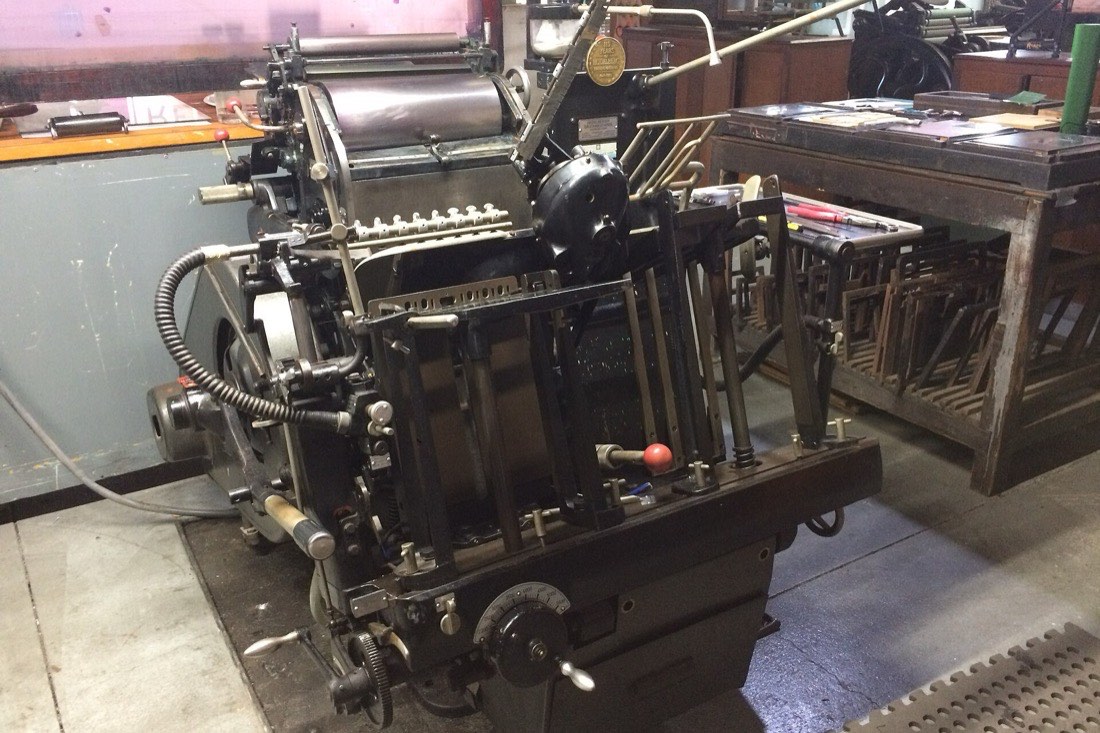
Kestrel Press started in 2016 in a railway arch off Feeder Road, with one Heidelberg, a borrowed guillotine and a hand-painted sign nobody could read from the road. We moved to Ashcombe Works in 2021, mostly for the light.
Today we split our time between commissions and our own editions. We print from metal and wood type, and occasionally from polymer plates when a job needs an illustration we cannot draw in reverse. Everything is set by hand, proofed on the press, and checked twice before it leaves the building.
A good impression is mostly a matter of paying attention. The rule pinned above the Heidelberg
Process
How a job moves through the room
-
01
Enquiry
Tell us what you are printing, roughly how many, and when you need it. A photograph of a previous job helps more than a paragraph.
-
02
Proof
We set a proof and print it on the stock we intend to use. You will see the real thing, on real paper, not a screen.
-
03
Lock-up
Type is locked into the forme, checked, and registered. Small changes after this point are possible, but they are expensive.
-
04
Press
We print in one or more passes, allowing each colour to dry. A small run takes a day; a large one takes a week.
-
05
Finishing
Trimming, scoring, folding and packing. We deliver locally, or pack flat for the post.
Equipment
What we print on
| Heidelberg Windmill | Platen press, 10 x 15, circa 1962. The workhorse for cards, stationery and small edition work. |
|---|---|
| Vandercook SP-15 | Proof press from the 1960s. Used for posters and longer editions, where a gentle, even impression matters. |
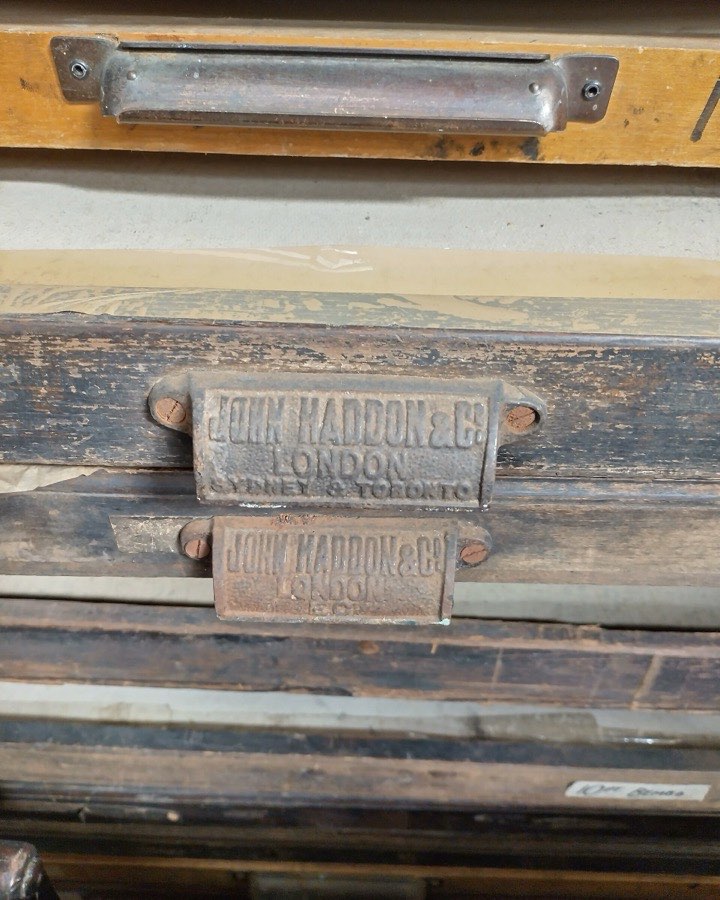
| Type | Around sixty cases of metal type, plus wood type from four to twenty-four line, much of it older than the building. |
| Guillotine | Polar 72 with a manual clamp. Sharpened more often than we would like. |
| Stock | 300gsm cotton rag, 120gsm text, grey board, and any paper you would like us to try. |
| Plates | Photopolymer for illustration and fine detail, made four streets away. |
Colophon
Image credits
- “Metal movable type” by Willi Heidelbach. Wikimedia Commons, CC BY 2.5.
- “Letterpress type cases at Washington University in St. Louis” by Michellecornelison. Wikimedia Commons, CC BY-SA 4.0.
- “Heidelberg Platen Press front-left” by Hoylen. Wikimedia Commons, CC BY-SA 4.0.
- “Letterpress drawers 01” by Smirkybec. Wikimedia Commons, CC BY-SA 4.0.
- “Letterpress posters by Amos Paul Kennedy Jr” by Michellecornelison. Wikimedia Commons, CC BY-SA 4.0.
- “Wood Type Specimen”, “Slab Serif Wood Type Specimen”, “Grecian Type Specimen” and “Hamilton Katz Blackletter type specimen” by James Puckett. Wikimedia Commons, CC BY 2.0.
- “Leavenworth Italian (reverse contrast) wood type”, Leavenworth / NYPL digitisation. Wikimedia Commons, public domain.
- “Merry Go Round Letterpress Print” by AlanKitching. Wikimedia Commons, CC BY 4.0.


Site set in Fraunces and Inter, both open-source typefaces.